

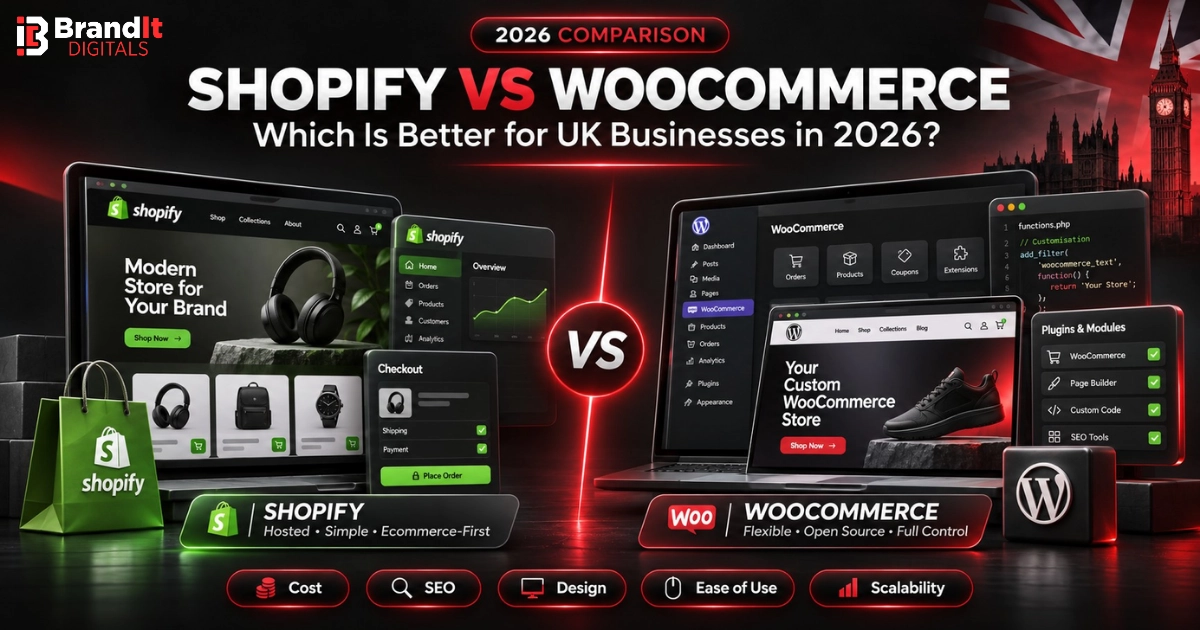
If you're launching or rebuilding an online store, choosing between Shopify and WooCommerce can influence almost every part of the business — from day-to-day management and website maintenance to design flexibility, payments, SEO and future growth.
Both platforms can power successful ecommerce businesses, but they solve the problem in fundamentally different ways.
Shopify is a hosted commerce platform designed to bring the major parts of running an online store into one managed ecosystem. WooCommerce is a free, open-source ecommerce platform built on WordPress, giving businesses substantially more control over their website and infrastructure.
So when comparing Shopify vs WooCommerce for a UK business, the right question is not simply which platform has more features. It is which platform better matches your business, technical requirements, internal resources and growth strategy.
Shopify or WooCommerce: Which Is Better?
For many ecommerce-first UK businesses that want to launch quickly, reduce technical maintenance and operate the store through one managed platform, Shopify is usually the simpler choice.
For businesses that already depend heavily on WordPress, require greater infrastructure control or need highly customised content and development architecture, WooCommerce can be the stronger fit.
Best for streamlined ecommerce
Shopify combines hosting, ecommerce management, security, checkout and the core store infrastructure within a managed commerce platform.
Best for simplicity & ecommerce operationsBest for control and flexibility
WooCommerce turns WordPress into an ecommerce platform and gives businesses greater control over hosting, code, plugins, content architecture and technical customisation.
Best for flexibility & WordPressShopify vs WooCommerce UK: Key Differences
This comparison summarises the practical differences most UK businesses should consider before choosing an ecommerce platform.
| Category | Shopify | WooCommerce |
|---|---|---|
| Platform type | Fully hosted commerce platform | Open-source ecommerce platform for WordPress |
| Ease of use | Generally easier for non-technical teams Advantage | More technical responsibility |
| Hosting | Included with Shopify plans Simple | Hosting selected and managed separately |
| Technical control | Controlled platform environment | Extensive server, plugin and code control Advantage |
| Maintenance | Core infrastructure managed by Shopify Advantage | Hosting, WordPress, plugins and technical maintenance need management |
| Design flexibility | Strong theme and custom development ecosystem | Very broad WordPress and development flexibility Control |
| Content management | Strong for ecommerce content | Built on WordPress, making advanced content publishing particularly flexible Advantage |
| Cost structure | Recurring platform subscription with more predictable core infrastructure | Free core software, but hosting, extensions and development vary |
| Ideal user | Ecommerce-first businesses wanting an easier managed platform | Businesses wanting WordPress flexibility and greater infrastructure control |
Which Is Cheaper: Shopify or WooCommerce?
This question is more complicated than comparing one monthly subscription against a free plugin.
WooCommerce's core software is free and open-source, while Shopify uses a recurring subscription model.
However, the total cost of operating an ecommerce store can also include hosting, premium themes, extensions, apps, development, technical support and ongoing maintenance.
Shopify UK currently includes hosting and SSL within its platform, while WooCommerce allows the business to choose its own hosting provider and infrastructure.
Shopify costs
PredictableShopify charges a monthly platform subscription. As of November 2026, the UK Basic plan is listed at £19 per month when billed annually.
Depending on your store, you may also pay for premium themes, apps, development and payment processing.
WooCommerce costs
FlexibleWooCommerce itself is free, but you still need WordPress hosting, a domain and potentially premium extensions, themes, security, backups and development support.
The final cost can therefore be very low for a simple setup or considerably higher for a complex commercial store.
Do not choose WooCommerce purely because the core software is free, and do not dismiss Shopify purely because it has a monthly subscription. Compare the total operating cost of the store.
Shopify vs WooCommerce for Ease of Use
Shopify is generally designed around making ecommerce operations accessible without requiring the merchant to manage the underlying server environment.
Hosting, SSL, the ecommerce dashboard and major platform updates are handled within the Shopify ecosystem.
WooCommerce gives you more control, but that control also creates additional responsibility.
- WordPress core updates
- Plugin compatibility
- WooCommerce updates
- Hosting performance
- Backups and security configuration
- Troubleshooting plugin conflicts
None of this means WooCommerce is difficult when properly managed. It means businesses should understand that it is a more self-managed technical environment.
Ease-of-use winner for most non-technical ecommerce teams: Shopify.
Which Gives You More Design Flexibility?
Both Shopify and WooCommerce can produce highly customised, professional ecommerce websites.
Shopify supports themes, custom sections, Liquid development, custom apps and headless builds.
WooCommerce sits within the wider WordPress ecosystem and allows developers extensive control over themes, plugins, server configuration, database behaviour and custom PHP development.
Shopify
Excellent when you want substantial customisation while retaining a structured, managed ecommerce environment.
WooCommerce
Excellent when your project requires unusually deep customisation or close integration with an existing WordPress website.
If unrestricted technical control is the priority, WooCommerce has the advantage.
If the objective is a highly customised ecommerce store without managing every part of the hosting stack, Shopify can be the more practical balance.
Shopify vs WooCommerce for SEO
Both Shopify and WooCommerce can rank successfully in Google. The platform alone does not determine whether your ecommerce website will perform well organically.
SEO performance depends on factors including technical health, content quality, search intent, internal linking, product and collection architecture, authority, page experience and ongoing optimisation.
Shopify SEO
Shopify provides many essential ecommerce SEO foundations out of the box and simplifies infrastructure management.
It can be a strong option for businesses primarily focused on ecommerce category, collection and product growth.
WooCommerce SEO
Because WooCommerce operates on WordPress, businesses have extensive control over content structures, publishing workflows, plugins and technical implementation.
This can be particularly valuable for content-heavy websites with complex editorial requirements.
For most businesses, we would not choose between Shopify and WooCommerce based solely on SEO.
Choose the platform that best supports the wider business, then build the correct SEO architecture around it.
BrandIt supports ecommerce projects alongside SEO and digital marketing , allowing the store structure and acquisition strategy to work together.
Hosting, Performance and Security
This is one of the clearest structural differences between Shopify and WooCommerce.
Shopify includes managed ecommerce hosting and SSL as part of its plans. That removes much of the server-level responsibility from the merchant.
WooCommerce allows you to choose your own host, server configuration and performance stack.
That can be an advantage when managed by an experienced technical team, but a poorly configured WooCommerce environment can suffer from unnecessary plugin load, hosting limitations or maintenance issues.
Shopify
ManagedBetter suited to businesses that want the core ecommerce hosting environment handled for them.
WooCommerce
ControlBetter suited to teams that want control over hosting, optimisation, server resources and the wider technical stack.
Shopify vs WooCommerce for Payments and Checkout
Shopify offers its own integrated payment solution, Shopify Payments, alongside support for other payment providers.
The Shopify checkout is part of the managed platform, meaning the checkout experience, security infrastructure and ecommerce workflow are tightly integrated.
WooCommerce gives businesses broader freedom to select payment gateways and configure the checkout through WordPress plugins, extensions and custom development.
Shopify generally offers the simpler checkout ecosystem. WooCommerce generally provides greater flexibility over how the checkout and payment stack are configured.
Which Platform Scales Better?
Both platforms can support serious ecommerce businesses.
Shopify scales within a managed commerce ecosystem. As the business grows, merchants can move through Shopify plans and, where appropriate, into Shopify Plus.
WooCommerce can also scale substantially, but the technical infrastructure becomes increasingly important as traffic, catalogue size and functionality grow.
Hosting architecture, caching, database performance, plugin quality and maintenance all become more significant.
- Higher traffic volumes
- Larger product catalogues
- International ecommerce
- Advanced integrations
- Custom operational workflows
- Multi-channel selling
For a business without an internal technical team, Shopify's managed architecture can make scaling operationally simpler.
For a business with experienced developers and highly specific infrastructure requirements, WooCommerce can provide exceptional flexibility.
Who Should Choose Shopify?
Shopify is usually worth serious consideration when your business is primarily ecommerce-focused and you want to reduce the amount of technical infrastructure you need to manage yourself.
- You want to launch an ecommerce store quickly
- Your team is not highly technical
- You want hosting and core infrastructure managed
- Ecommerce is the primary purpose of the website
- You want straightforward day-to-day store management
- You expect to scale product sales internationally
- You prefer predictable platform management
- You want a strong app and commerce ecosystem
For these businesses, our Shopify development service focuses on building the customer experience around conversion, usability, brand positioning and long-term growth.
Who Should Choose WooCommerce?
WooCommerce can be an excellent choice when WordPress is already central to the business or when the technical flexibility of an open-source platform provides a meaningful advantage.
- You already operate a substantial WordPress website
- Content publishing is central to your acquisition strategy
- You want to choose and control your own hosting
- You need deep WordPress integration
- You require extensive code-level flexibility
- You have access to ongoing technical support
- You want full control over the wider website stack
- Your requirements go beyond a standard ecommerce setup
Shopify or WooCommerce: Which Should Your Business Choose?
Start with your business situation rather than choosing the platform because it is currently popular.
New ecommerce startup
You want a professional store without taking responsibility for hosting and core infrastructure.
Consider ShopifyExisting WordPress business
You already have substantial WordPress content and want commerce integrated into the existing ecosystem.
Consider WooCommerceGrowing DTC brand
Ecommerce is becoming a major revenue channel and operational simplicity is important.
Consider ShopifyContent-heavy organisation
Publishing, resources and custom content architecture are as important as ecommerce itself.
Consider WooCommerceSmall non-technical team
You want staff to manage products, orders and customers with minimal technical responsibility.
Consider ShopifyHighly bespoke platform
You require unusual workflows, infrastructure control or extensive WordPress-based custom development.
Assess WooCommerceThe Simple Way to Decide
Choose Shopify if you prioritise:
- Ease of management
- Managed hosting
- Lower technical overhead
- Ecommerce-first operations
- Integrated checkout
- Fast deployment
- Predictable platform infrastructure
Choose WooCommerce if you prioritise:
- Open-source control
- WordPress integration
- Hosting freedom
- Custom technical architecture
- Advanced content publishing
- Plugin ecosystem flexibility
- Code-level ownership and customisation
Why DayFlow Needed More Than a Basic Store Setup
DayFlow needed an ecommerce foundation that felt professional, trustworthy and easy for customers to navigate rather than simply placing products into a standard template.
BrandIt developed the Shopify experience around stronger product presentation, custom sections, mobile usability and a clearer buying journey.
- Custom Shopify store design
- Custom-coded sections
- Individual product-page design
- Mobile-first optimisation
- Trust-focused customer experience
- Conversion-oriented store structure
The important point is not that Shopify is automatically the best platform for every business.
It was the right foundation for the ecommerce experience DayFlow needed.
Still Not Sure Which Ecommerce Platform to Use?
The best platform is determined by your business model, catalogue, team, integrations, content strategy and long-term operational requirements.
Migrating ecommerce platforms later can involve product data, customers, redirects, analytics, integrations and SEO considerations. It is therefore worth making the platform decision carefully before development begins.
BrandIt works across Shopify and ecommerce development as well as broader web development , allowing the recommendation to be based on the actual project requirements rather than forcing every business onto the same stack.
Shopify vs WooCommerce UK: FAQs
Here are answers to common questions businesses ask when comparing Shopify and WooCommerce.
Is Shopify or WooCommerce better for a UK small business?
Shopify is often easier for a small business that wants a managed ecommerce platform with hosting and core infrastructure included. WooCommerce can be better when the business already uses WordPress extensively or needs greater technical control. The right choice depends on your requirements rather than business size alone.
Is WooCommerce cheaper than Shopify?
WooCommerce's core software is free, while Shopify uses a monthly subscription. However, a WooCommerce store still requires hosting and may require paid themes, extensions, development, maintenance and security services. Compare total ownership costs rather than the initial software price alone.
Which is better for SEO, Shopify or WooCommerce?
Both Shopify and WooCommerce can perform strongly in organic search when implemented correctly. WooCommerce offers extensive WordPress-level control, while Shopify simplifies much of the technical infrastructure. Content quality, site architecture, search intent, authority and technical execution matter more than simply choosing one of the two platforms.
Is Shopify easier to use than WooCommerce?
For many non-technical users, Shopify is generally easier to operate because hosting, security and the core commerce system are managed within one platform. WooCommerce provides more technical freedom but usually requires greater involvement in hosting, plugins, updates and maintenance.
Does WooCommerce have a monthly fee?
WooCommerce itself does not have a mandatory monthly platform subscription. However, businesses normally pay for hosting and may also pay for premium extensions, payment processing, development, security, backups or maintenance depending on their setup.
Can I move from WooCommerce to Shopify later?
Yes. Products, customers and other store data can be migrated from WooCommerce to Shopify. A professional migration should also account for URLs, redirects, SEO, analytics, applications, order data and any custom functionality used by the existing store.
Which platform is better for a growing ecommerce brand?
Shopify is often attractive to growing ecommerce-first brands because the hosted platform reduces infrastructure management. WooCommerce can also scale effectively when supported by strong hosting and experienced developers. The better choice depends on how much technical control the business needs.
Should I choose Shopify or WooCommerce for my new online store?
Choose Shopify if you value a streamlined managed ecommerce environment and lower day-to-day technical responsibility. Consider WooCommerce if you need WordPress integration, infrastructure freedom or extensive technical customisation. For complex requirements, define the store specification before selecting the platform.
Shopify vs WooCommerce: There Isn't One Winner for Every Business
Shopify and WooCommerce are both capable ecommerce platforms, but they serve different operational priorities.
Shopify is usually the stronger choice when simplicity, managed infrastructure and ecommerce operations are the priority.
WooCommerce is usually the stronger choice when WordPress integration, infrastructure ownership and technical flexibility are more important.
The platform should support the business model rather than force the business to work around the platform.
Before development begins, define your products, integrations, content requirements, operational workflow, acquisition strategy and growth plans. That makes the Shopify vs WooCommerce decision much clearer.
Not Sure Whether Shopify or WooCommerce Is Right for Your Business?
BrandIt can review your ecommerce requirements and recommend the right platform, store structure and development approach based on how your business actually needs to operate and grow.